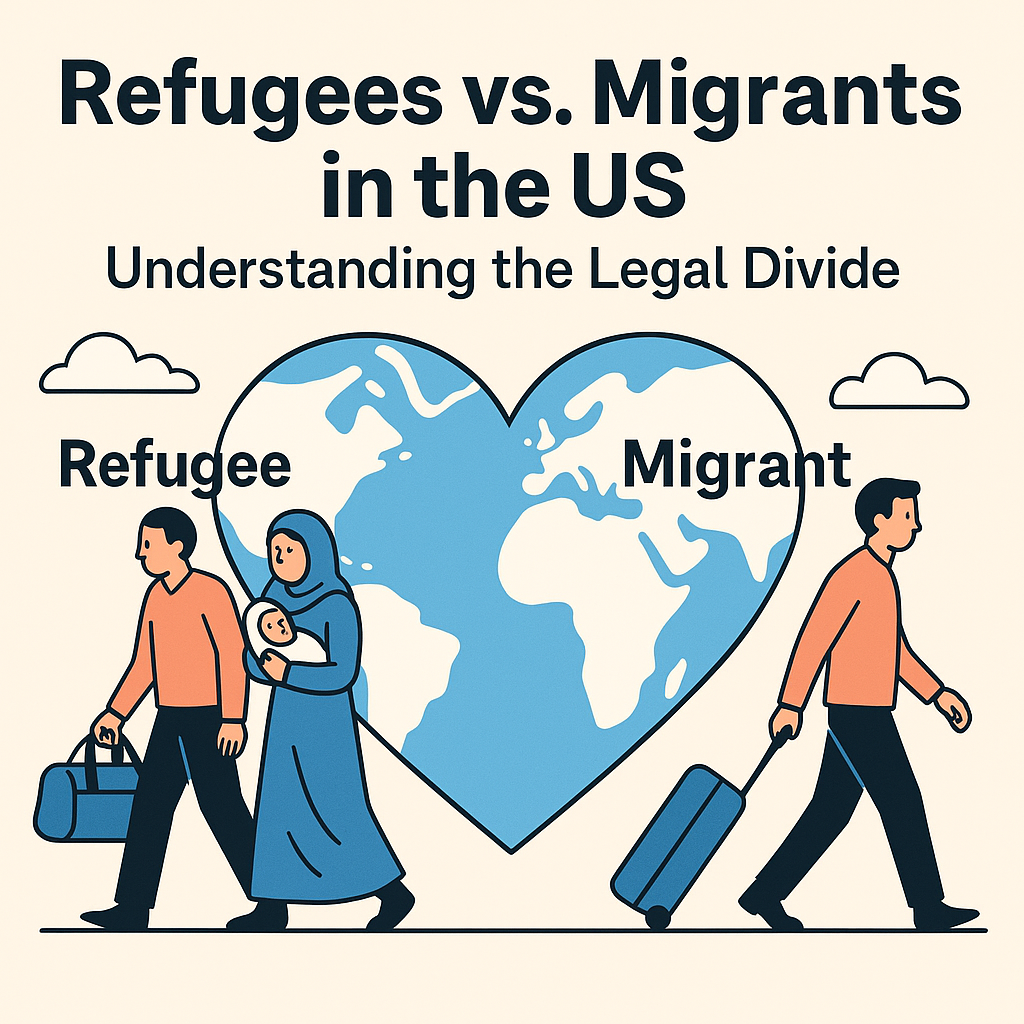
Refugees, as well as migrants, move from one place to another, but there exist different reasons for their movement. Refugees are those who are compelled to move owing to the fear of maltreatment, violence, or conflict. On the other hand, migrants are those who move because of economic and social reasons.
The United States is the place where a lot of people move every year, be it refugees, migrants, or any other persons. Since 1975, more than 3.6 million refugees have entered the US, and as of 2023, there were more than 47.8 million migrants residing in the US.
This number in the US continues to burgeon. But, is there any legal status granted to them? In this article, we will be exploring the present status of refugees and migrants in the US and what challenges they face. We will also be seeing the possible remedies that are available to them, along with their distinction.
The definition of refugees arises from the UN 1951 Convention and 1967 Protocols, which relate to the status of refugees.
A refugee under US law has been defined as any person who is not willing or unable to return to the home country, either because of persecution or fear of persecution, mainly because of the following reasons:
For instance, many Syrians have been granted the status of refugee in the US due to the ongoing civil war and humanitarian crisis in their country. A similar situation can be seen with people of Afghanistan as well, when the Taliban regained control in 2021, and consequently, the refugee status and humanitarian parole were granted to many people by the US.
It is pertinent to note that asylum seekers are persons who meet the eligibility criteria for refugees and are seeking protection after entering the US. Moreover, internally displaced persons and stateless persons appear to be similarly vulnerable as refugees, but they fall outside the framework of refugees under immigration law.
Migrants are not legally defined as per any US law. However, according to the International Organization for Migration, a migrant is a person who is moving or has actually moved across an international border.
A refugee who has been residing in the US for more than a year after being granted the status of refugee may apply for permanent residency (i.e., Green Card), and this can be done through the process named “adjustment of status”.
Based on this process, refugees can make a transition from temporary protection to permanent residency status. Once permanent residency is granted through a green card, refugees can enjoy several rights, such as the right to live and work, sponsor family members for immigration, and apply for US citizenship after a certain period.
The resettlement of refugees has a profound impact, especially in the underpopulated areas of the US, by filling the labour shortage and starting a small business. Moreover, refugees bring cultural diversity with their continuous engagement in the community, thereby exemplifying the economy as well as the culture of the US.
In order to apply for a green card (lawful permanent residency) in the US, there are certain eligibility criteria, which are as follows:
There are certain instances when refugees can be denied permanent residency status in the US, which are as follows:
If a person wishes to migrate to the US, then residency rights can only be granted when they receive a green card that confers lawful permanent residency.
But the person who wishes to migrate must decide for which visa they’re eligible. A person can only avail permanent residency status if they qualify for any of the following categories of green card:
If anybody is currently a US citizen or green card holder, then a green card may be issued to their family members. The family members who are eligible under this scenario include:
However, it is pertinent to note that this rule may vary depending on the fact whether the person who’s sponsoring the family is a US citizen or merely a green card holder.
It is often observed that many people migrate to the US with the help of an employment-based green card, which is issued under five categories:
In the US, there exists a system popularly known as the “green card lottery”, which randomly grants an immigrant visa. Every year, approximately 55,000 people get an immigrant visa with the help of the green card lottery.
Only people from those countries are eligible to apply for the green card lottery who have a low immigration rate to the US.
The US government may issue other types of green card to different categories of people, such as media persons, religious workers, employees of international organizations, etc., each under different eligibility criteria.
| Basis | Refugee | Migrants |
|---|---|---|
| Reason for their movement | They majorly move due to the fear of persecution, due to war or violence. | Their movement is voluntary, and it can be due to various reasons such as work, education, family, or a better life experience. |
| Legal protection | The Refugee Act, 1980 is the primary legislation that provides protection to refugees in the US. | For immigrants, protection is provided through US immigration law via visas, green cards, etc. |
| Right to work | Granted, shortly after their arrival. | Depends on the type of visa, and the right to work is not granted automatically. |
| Access to healthcare and education | Refugees have access to these facilities due to their designated status. | For migrants, these facilities vary depending on their visa and status, and for undocumented immigrants, accessing these services might be difficult. |
| Path to permanent residency and citizenship | Refugees are eligible to apply for a green card after 1 year, and after a period of 5 years, they can apply for citizenship. | Varies significantly for different visas. However, it may take years to finally get such right. |
| Legal protection against deportation | Strong protection under asylum and refugee laws. | Limited protection; a migrant can be deported if they’re out of status or undocumented. |
| Process to enter | A person seeking the status of refugee in the US must apply through the US Refugee Admission Process (USRAP). | Apply for an appropriate visa. |
| Annual cap on the entry | The President, in consultation with Congress, sets up the cap every year. For FY 2023, 2024, and 2025, the cap was set to 125,000. | Congress decides the annual cap on the entry of immigrants every year with respect to each category of visa (e.g., 226,000 for family-sponsored preference; 140,000 for employment-based). |
| Numbers | More than 3.6 million refugees have entered the US since 1975. | In 2023, there were 47.8 million immigrants living in the US. |
| Major areas from where they come | From 2011 to 2023, a total of 624,589 refugees arrived in the US; the majority were from Myanmar (18.8%), the Democratic Republic of the Congo (15.7%), and Iraq (15%). | The majority of immigrants in the US come from Mexico (23%), India (6%), China (5%), the Philippines (4%), etc. |
From the above discussion, it can easily be inferred that there are certain legal gaps between refugees and migrants, and it is observed that refugees as well as migrants face significant challenges while moving to another country.
Although the gap that is persisting is never going to end completely, with some reforms, it can be minimized to make sure that it becomes easy for both groups to shift to a new country. This may be done by:
From the above discussion, it can be inferred that refugees and migrants move from one place to another to seek better opportunities, safety, and stability.
Every year, the US offers various refugees and migrants to settle and start their lives with the expectation of continuous growth in the future. In contrast to this anticipation, the process to actually move to the US is backed by a complex procedure and various challenges.
Moreover, we can clearly observe that there exist different legal divisions between the groups. If these gaps are handled with effective reforms while acknowledging the contribution of refugees as well as migrants, then we may ensure equal opportunities for all without any hindrance.

Join the newsletter
Subscribe for weekly updates.
Attorney Advertising. Rathee Law Firm P.C., New York. The information on this website is for general informational purposes only and does not constitute legal advice or create an attorney-client relationship. Prior results do not guarantee a similar outcome. Please consult an attorney for advice about your individual situation.
Copyright © Rathee Law Firm P.C. 2026 · Privacy Policy · Schedule Consultation