For decades, F-1 students were admitted to the United States for "duration of status," shown as "D/S" on the Form I-94 arrival record. The I-94 carried no fixed departure date. A student could remain in the United States while maintaining F-1 status, engaging in authorized practical training, or, in some circumstances, during an applicable post-completion grace period. A post-completion grace period is generally a period of authorized stay rather than continuing active F-1 status, and that distinction matters in some of the situations discussed below.
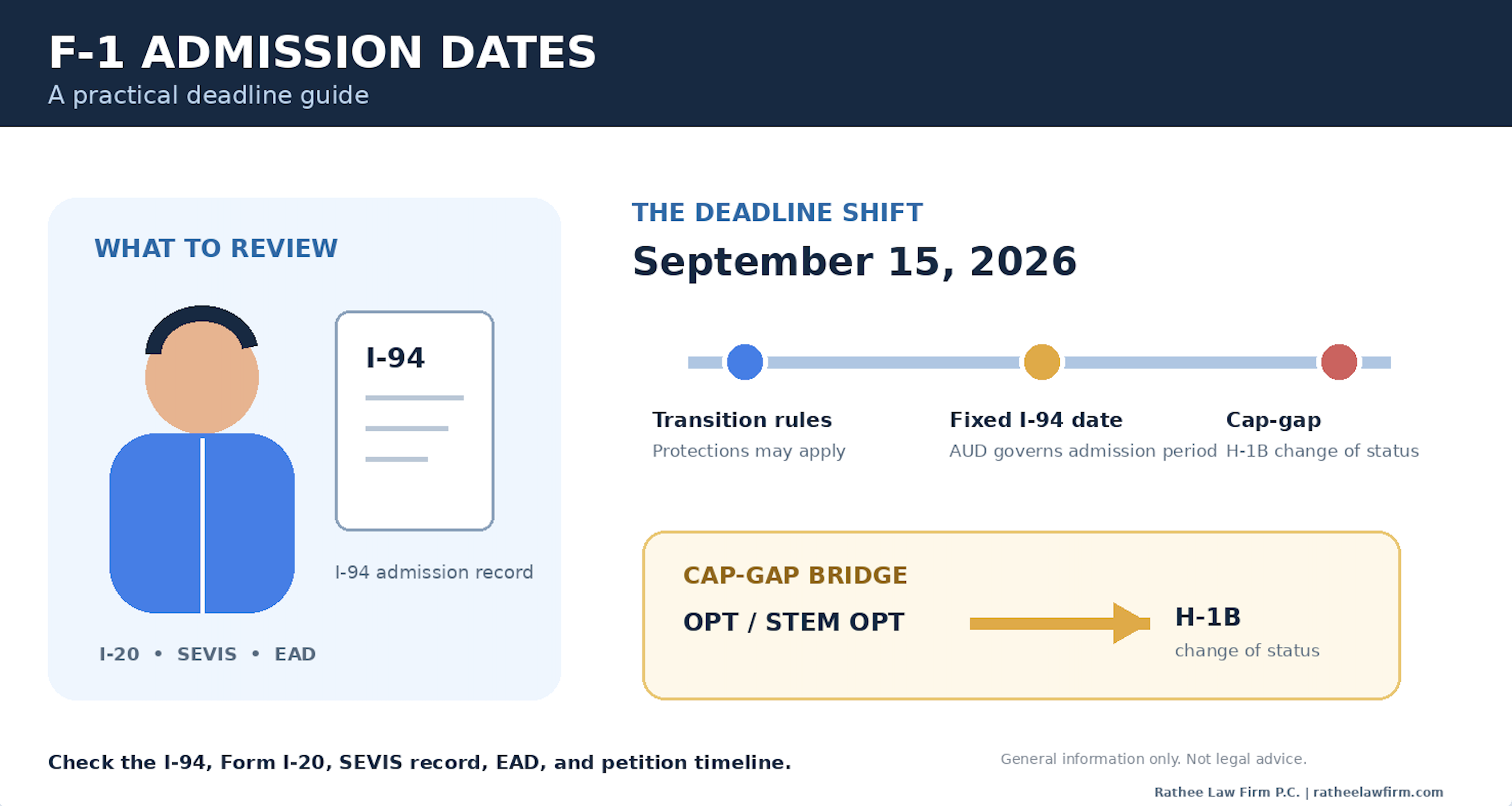
That framework changes on September 15, 2026. The Department of Homeland Security published a final rule on July 17, 2026 that replaces D/S admissions for F, J, and I nonimmigrants with a fixed admission period, called an Admit Until Date (AUD). The AUD is the expiration date that will appear on the I-94.
The new fixed-AUD framework does not apply in the same way to every F-1 student on September 15. Students admitted or readmitted on or after that date generally receive a fixed admission period. Students already in the United States in valid F-1 status on that date may qualify for transition protections. Which group you fall into drives everything else in this article: OPT, STEM OPT, H-1B cap-gap, travel and Form I-9 reverification.
At a glance
- Starting September 15, 2026, F-1 students admitted or readmitted to the United States will generally receive a fixed I-94 date rather than D/S.
- Students already in valid F-1 status in the U.S. on September 15 may qualify for transition protections that run as late as November 14, 2030.
- Form I-539 will be needed for extensions of stay, including OPT and STEM OPT, subject to a limited transition provision through March 18, 2027.
- H-1B cap-gap remains available for qualifying change-of-status petitions.
- Travel, I-94 dates, OPT EAD dates, and H-1B filing dates now have to be coordinated carefully.
Beginning September 15, 2026, an F-1 student admitted or readmitted to the United States will generally receive a fixed period of admission rather than D/S. The period is tied to the program dates on Form I-20, subject to a four-year maximum, together with the additional arrival and departure time specified in the rule (a 30-day period associated with arrival and a 30-day period associated with departure).
Students should not assume the program end date on the I-20 is the only date that matters. After the rule takes effect, the I-94 and its AUD will be central to determining the period of authorized admission. Students must also continue to comply with the requirements of F-1 status, including the program information in SEVIS and on Form I-20 and any applicable practical-training rules.
A valid F-1 visa stamp does not by itself establish how long a student may remain in the United States. Under the new framework, review the Form I-94 issued after each admission, along with the Form I-20, SEVIS record and any practical-training documentation.
Under the new framework, an F-1 student who needs time beyond the AUD generally must either:
Situations that can require an I-539 include:
The rule includes a limited reprieve for practical training applicants. For a limited transition period, certain F-1 students seeking post-completion OPT or STEM OPT may file Form I-765 without a separate Form I-539 if the I-765 is filed on or before March 18, 2027, before the current period of admission, including any applicable departure period, expires, and the student otherwise meets the transition requirements. The preamble describes this as a short-term reprieve during the first six months after the effective date. See 8 C.F.R. § 214.1(m); 91 Fed. Reg. 44,978. DHS has authority to extend the date.
After March 18, 2027, students should expect to file Form I-539 with the relevant OPT or STEM OPT filing unless DHS extends the transition period. Check USCIS for the current edition of every form before filing, and confirm current USCIS and SEVP instructions because implementation guidance may change.
The rule creates two groups of F-1 students.
If you were admitted for D/S before September 15, 2026 and were properly maintaining F-1 status in the United States on that date, you may qualify for the transition provisions in 8 C.F.R. § 214.1(m). If you do, you are authorized to remain in F-1 status until the later of:
followed by a departure grace period of up to 60 days. There is an outside limit: the transition period cannot run past November 14, 2030 (four years from the effective date plus 60 days).
If you had an OPT or STEM OPT I-765 pending on September 15, 2026 and were maintaining status, you may also qualify. If the EAD is approved, the "later of" rule above applies using the EAD end date. If the I-765 is denied, the student's remaining period of authorized stay depends on the transition provision, the student's program-completion status, the Form I-20 end date, and any other pending immigration filing. Obtain prompt advice rather than assuming that a denied OPT application creates a new or extended period of stay.
The exact consequences of an OPT denial, a later extension filing, a change of education level, travel, or an H-1B filing should be assessed under the regulation and current USCIS and SEVP guidance.
You are governed by the fixed-AUD framework, not the transition rules, if you:
That last point catches a lot of people. A winter trip abroad can move a student from Group 1 to Group 2. It is not necessarily harmful, but it changes the rules that apply. Students covered by the transition framework generally receive up to a 60-day departure period, while students admitted or readmitted under the fixed-AUD framework generally receive a 30-day period following the relevant program or practical-training end date, subject to the specific regulatory conditions and the student's compliance with F-1 requirements. The exact period and any available filing options depend on the individual's status history, program or OPT end date, I-94 record, and, where relevant, the reason an H-1B petition or change-of-status request was not approved.
| Issue | D/S transition student | Student admitted under fixed AUD |
|---|---|---|
| Framework | Transition protections if admitted D/S before 9/15/26 and maintaining status on that date | Fixed I-94 admission period |
| Key documents | Form I-20, EAD if applicable, transition-rule analysis | Form I-94 AUD, Form I-20, EAD if applicable |
| Outer limit on stay | Later of EAD expiration or I-20 program end date, plus up to 60 days, no later than 11/14/2030 | I-94 AUD, then I-539 or departure |
| Post-completion departure period | Generally up to 60 days, subject to regulatory conditions | Generally 30 days after the relevant program or practical-training period, subject to regulatory conditions |
| Travel after 9/15/26 | Readmission moves you to the fixed-AUD framework | Already under fixed-AUD framework |
| OPT / STEM OPT | A limited I-765-only transition provision may apply through March 18, 2027 if all regulatory conditions are met; otherwise, assess whether Form I-539 is required | A limited I-765-only transition provision may apply through March 18, 2027 if all regulatory conditions are met; otherwise, assess whether Form I-539 is required |
| H-1B cap-gap | Available if a qualifying change-of-status petition is timely filed | Available if a qualifying change-of-status petition is timely filed |
The March 18, 2027 transition provision is not automatic. Eligibility depends on the regulatory conditions, including the timing of the filing and the student's current period of admission or departure period.
"Cap-gap" describes the period between the end of a student's F-1 program or post-completion OPT and the start of H-1B status under a qualifying cap-subject petition. Under the H-1B Modernization Rule (effective January 2025) and current USCIS guidance, an eligible F-1 student who is the beneficiary of a timely filed cap-subject H-1B petition requesting a change of status may receive an automatic extension of the student's period of authorized stay. If the student is in valid post-completion OPT or STEM OPT when the qualifying petition is filed, the extension may also cover employment authorization. The extension generally runs through April 1 of the relevant fiscal year or the approved H-1B petition's validity start date, whichever is earlier.
There are two forms of cap-gap protection:
Cap-gap is available only where the H-1B petition requests a change of status. A petition filed for consular notification does not create the automatic extension.
DHS stated in the preamble that the rule does not eliminate the cap-gap automatic extension or the STEM OPT extension provisions. Eligible students may continue to benefit from cap-gap when the regulatory requirements are satisfied. See 91 Fed. Reg. 45,045-46; 8 C.F.R. § 214.2(f)(5)(vi).
The final rule preserves cap-gap but changes the timing analysis for students admitted under the fixed-AUD framework. Under the new rule, a cap-subject H-1B petition requesting a change of status is timely filed for cap-gap purposes if it is properly filed before the later of:
DHS has stated that the rule does not eliminate cap-gap, but USCIS and SEVP have not yet issued detailed implementation guidance on every interaction between the AUD, the Form I-20 program end date, the OPT EAD date, and cap-gap. Students and employers should confirm current guidance before relying on a filing timeline. See 8 C.F.R. § 214.1(m); 91 Fed. Reg. 45,045-46.
In the meantime, identify every relevant deadline early:
An employer timely files a cap-subject H-1B petition requesting a change of status for an eligible F-1 student before the relevant OPT, admission, and departure-period deadlines expire. If cap-gap applies, it may extend the student's period of authorized stay and, where applicable, work authorization through April 1 of the requested fiscal year or the approved H-1B petition's validity start date, whichever comes first. If the petition is approved, the student may continue authorized employment through the H-1B start date, subject to the approval and the applicable cap-gap rules, and then moves into H-1B status. Where cap-gap applies, the automatic extension may bridge the period between the end of OPT or STEM OPT and the H-1B start date. Whether a separate Form I-539 is required at another point in the student's timeline depends on the student's admission record, OPT or STEM OPT filing history, and the new extension-of-stay rules. This example assumes that the student has satisfied any separate Form I-539 requirement that applied to the student's move into OPT or STEM OPT under the fixed-AUD framework.
If the H-1B petition is denied, withdrawn, revoked or rejected
Cap-gap employment authorization ends when the qualifying H-1B petition or change-of-status request is denied, withdrawn, revoked, rejected, or otherwise ceases to support the extension. See 8 C.F.R. § 214.2(f)(5)(vi)(B).
For students covered by the pre-September 15, 2026 D/S transition rules, the rule preserves a 60-day departure period in many circumstances. Students admitted under the fixed-AUD framework generally have a shorter 30-day period after the relevant program or practical-training period ends, subject to the regulatory conditions.
The interaction between a fixed I-94 admission date, cap-gap termination, and any remaining departure period may depend on the timing and reason for the H-1B decision. A student should obtain individualized advice immediately after an adverse decision and should not assume that an earlier OPT expiration date, a cap-gap extension, or a pending filing creates additional time to remain or work.
I am on OPT now. Do I need to file an I-539 right away? Possibly not. If you were admitted for D/S before September 15, 2026 and were properly maintaining F-1 status in the United States on that date, you may qualify for the transition protections. In that case, you may remain through the later of the applicable EAD end date or Form I-20 program end date, followed by the applicable departure period, subject to the outer transition limit. Whether and when you need Form I-539 depends on your specific timeline, travel, practical-training plans, and any extension-of-stay requirement under the new rule.
Can I still go home for the holidays? You can, but understand what it does. On return you will be admitted with a fixed AUD and the transition rules stop applying to you. Speak with your DSO and, if an H-1B is pending, your attorney before booking.
Does this rule affect J-1 and I visa holders? Yes. The rule ends D/S for J and I nonimmigrants as well, with different transition periods. This article covers F-1 students only.
Where can I read the rule? The Federal Register publication is linked in the sources below. Check the USCIS and Study in the States websites for current implementation guidance, forms, and filing instructions.
The new rule adds deadlines and filings to a process that already had little margin for error. Whether you are a student mapping out OPT and the H-1B lottery, or an employer trying to keep an I-9 file clean through a cap-gap extension, it is worth getting the timeline right before a date passes.
Rathee Law Firm P.C. represents students, graduates and employers in F-1, OPT, STEM OPT and H-1B matters from our office at 501 Fifth Avenue in Manhattan. Contact us to review your situation.
Sources
Last reviewed September 1, 2026.
This article is for general information only and is not legal advice. Reading it does not create an attorney-client relationship. The rule is new and USCIS and SEVP implementation guidance may change; confirm current requirements before acting.

Join the newsletter
Subscribe for weekly updates.
Attorney Advertising. Rathee Law Firm P.C., New York. The information on this website is for general informational purposes only and does not constitute legal advice or create an attorney-client relationship. Prior results do not guarantee a similar outcome. Please consult an attorney for advice about your individual situation.
Copyright © Rathee Law Firm P.C. 2026 · Privacy Policy · Schedule Consultation